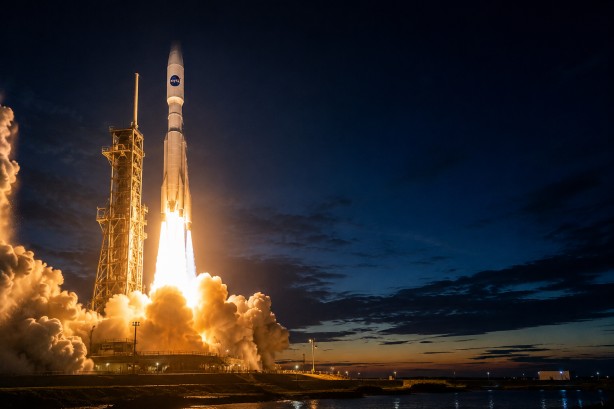
NASA has successfully launched the Nancy Grace Roman Space Telescope from Florida, marking the beginning of a groundbreaking mission set to transform our understanding of the universe. This $4.3 billion project aims to provide insights into the formation of planets and galaxies, explore exoplanets, and tackle some of the cosmos’ most profound mysteries. Departing from NASA’s Kennedy Space Center aboard a SpaceX Falcon Heavy rocket, the telescope embarks on its journey toward a location nearly one million miles from Earth, entering a crucial new phase after nearly a decade of development.
The Roman Space Telescope is designed to work alongside the Hubble and James Webb Space Telescopes, rather than replace them. Equipped with a powerful 300-megapixel infrared camera, it will deliver images that match Hubble’s resolution while covering a sky area at least 100 times larger. Each snapshot will capture an expanse about 1.5 times the apparent size of the full Moon. A key component of the telescope is its coronagraph, which can block the intense glare of stars, potentially allowing scientists to study orbiting planets in greater detail and discover previously unseen worlds, including older, colder ones in close orbits.
The telescope is set to reach the Sun-Earth Lagrange Point 2, a stable space location also used by the James Webb Space Telescope. From this vantage point, it will conduct a broad range of observations over its planned five-year primary mission, with the possibility of extension. Researchers anticipate that Roman’s wide-field observations will yield new insights into dark matter, dark energy, distant galaxies, exploding stars, black holes, and exoplanets. It may also help identify targets for more detailed follow-up studies by its predecessor telescopes, Hubble and Webb.
Roman’s journey to launch has been a significant achievement, especially given past budgetary challenges. The mission faced potential cancellation under previous White House budget plans, but Congress ultimately secured the necessary funding. This commitment reflects the importance of Roman’s potential contributions to our understanding of the universe’s expansion, planetary formation, and cosmic evolution over billions of years.
As the telescope makes its way to its operational location, the first scientific images are anticipated in early 2027, following months of testing and calibration. NASA intends to make these images publicly accessible, offering both researchers and amateur astronomers a wealth of new astronomical data. Roman’s launch signifies a promising new chapter in NASA’s exploration of the cosmos, poised to deliver invaluable insights into the workings of our universe.