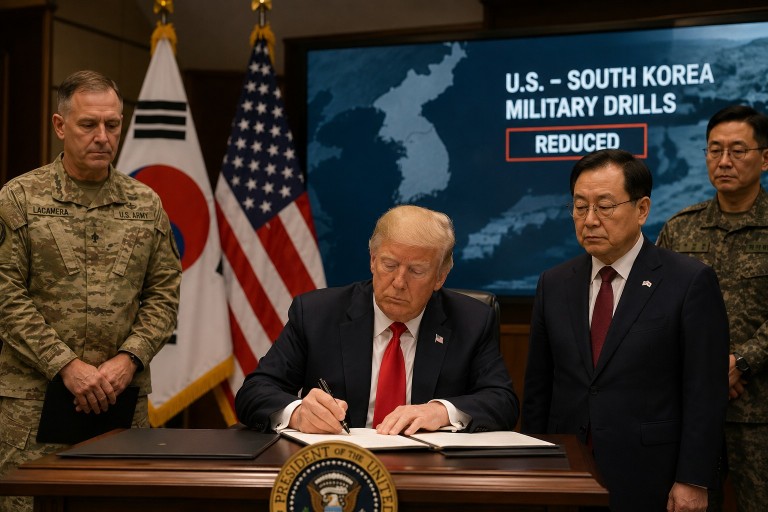
US President Donald Trump has announced a significant reduction in the scale of joint military exercises with South Korea, citing their high costs and the potentially negative message they send to North Korea. This decision is tied to what Trump describes as his “very good relationship” with North Korean leader Kim Jong-un. The Ulchi Freedom Shield exercises, which were set to commence on Monday and run through August 27, involve approximately 18,000 South Korean troops alongside US forces and personnel from several United Nations Command member states.
While Trump acknowledged that it was too late to completely cancel the upcoming drills, he directed Defence Secretary Pete Hegseth to notably decrease the level of US participation. Despite this directive, South Korea’s defence ministry has confirmed that the exercises will proceed as initially planned. This development occurs amid warnings from US and South Korean military officials about North Korea’s growing battlefield expertise, gained through its military collaboration with Russia in the ongoing conflict in Ukraine.
North Korea has reportedly dispatched over 14,000 troops to assist Russian forces, supplying artillery ammunition and ballistic missiles in the process. Military analysts suggest that these deployments are allowing North Korean forces to enhance their skills in modern warfare technologies, such as drones, GPS disruption, cyber operations, and missile systems. US military officials have indicated that the exercises have been adjusted to address these changing threats, cautioning that the knowledge gained by North Korean troops in Ukraine could bolster Pyongyang’s military strength upon their return.
Previously, Trump has taken steps to either reduce or halt major US-South Korean military exercises during diplomatic engagements with Kim. This latest move has reignited concerns in Seoul about the strength of the US-South Korea alliance and regional security. South Korean experts have voiced apprehensions that scaling back the exercises might undermine readiness and deterrence capabilities, while offering minimal diplomatic advantages given North Korea’s consistent demands for the drills’ complete cessation.
North Korea has long viewed the joint exercises as a precursor to an aggressive conflict and has issued threats of more robust military responses. In anticipation of the drills, Pyongyang has also conducted ballistic missile tests. Despite the US’s decision to downsize its participation, South Korean officials emphasize that the joint exercises are crucial for preparing against an increasingly sophisticated North Korean military threat.