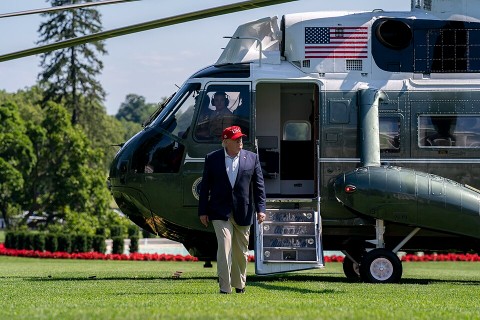
In a noteworthy development, former President Donald Trump stated on Wednesday his intention to speak with Taiwan’s President Lai Ching-te, a move that could potentially affect U.S.-China relations. Speaking to reporters at Joint Base Andrews in Maryland before departing on Air Force One, Trump remarked, “I’ll speak to him,” indicating his willingness to address what he termed “the Taiwan problem.” This statement follows Trump’s previous indication, dispelling initial speculation that his mention of the conversation after meeting with Chinese President Xi Jinping was unintended.
In response to Trump’s comments, Taiwan’s foreign ministry announced that President Lai would be pleased to engage in dialogue with the U.S. leader. This marks a significant potential interaction, as U.S. and Taiwanese presidents have not communicated directly since Washington transferred its diplomatic recognition from Taipei to Beijing in 1979. Trump’s conversation with then-Taiwan President Tsai Ing-wen in 2016, prior to his presidency, broke this longstanding diplomatic norm, prompting China to express its discontent.
China has consistently opposed U.S. military support for Taiwan and has not ruled out using force to claim the island it considers its territory. Despite this tension, Trump has approved more weapons sales to Taiwan than any previous U.S. president, although he has referred to these sales as a “very good negotiating chip.” His relationship with Xi has been described as “amazing,” yet uncertainty looms over a pending $14 billion arms deal with Taiwan, with Trump undecided on proceeding with the transaction.
Amid these diplomatic intricacies, Beijing is reportedly delaying a potential visit to China by Elbridge Colby, the Pentagon’s undersecretary of defense for policy, until Trump makes a definitive decision regarding the arms sale. China’s stance is clear, as it communicates that any direct U.S.-Taiwan contact would be seen as contentious. Meanwhile, President Lai has reiterated Taiwan’s commitment to maintaining peace across the Taiwan Strait, asserting that it is China’s military expansion that threatens regional stability.
Under U.S. law, Washington is mandated to equip Taiwan with defensive capabilities, and bipartisan support in Congress for continued weapons sales underscores Taiwan’s strategic significance. With a population of 23 million, Taiwan ranks as the fourth-largest trading partner of the United States, underscoring its economic importance, particularly in the semiconductor sector, which is pivotal to global commerce.